
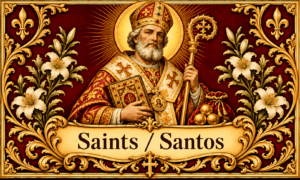
Long before the red suit, the reindeer and the North Pole, there was a bishop. The man the world calls Santa Claus is St. Nicholas of Myra, a fourth-century Catholic bishop whose feast the Church still keeps every December 6. To tell his story in the Church’s tradition is to see that the cheerful gift-giver of Christmas started out as a shepherd of souls, a defender of the faith and a model of hidden charity.
A Boy from Patara
Nicholas was born around the year 270 in Patara, a port town in Lycia, on the southern coast of what is now Turkey. Tradition says his parents were devout and wealthy, and that they died in an epidemic while he was still young. Nicholas took Our Lord’s words to the rich young man literally: “Go, sell what you have, and give to the poor.” He set out to give away his inheritance, and to do it in secret.
The Three Bags of Gold
The best-loved story about Nicholas is the one that turned him, centuries later, into Santa Claus.
A poor man in his town had three daughters and no money for their dowries. Without dowries they could not marry, and they faced being sold into servitude or worse. Nicholas heard of their plight. One night he threw a bag of gold through the family’s window, and it landed in a stocking hung by the fire to dry. He did the same for the second daughter. When he came the third time, the father was waiting to see who their benefactor was. Nicholas begged him to tell no one.
The roots of several Christmas customs lie in this one act of charity:
- Stockings by the fire. They recall where the gold landed.
- Oranges or gold coins in the toe. They recall the bags of gold.
- Secret giving. Gifts arrive from someone unseen, so that only God sees the giver. This is Christ’s command in Matthew 6:3–4: “Do not let your left hand know what your right hand is doing.”
The three gold balls that became the old sign of pawnbrokers also come from this story. That is why St. Nicholas is, among other things, their patron.
Bishop of Myra
As a young man, Nicholas made a pilgrimage to the Holy Land. When he came home, he arrived in Myra just as the bishops were gathering to choose a new bishop for the city. Tradition says one of them had dreamed that the first man named Nicholas to enter the church the next morning should be chosen. Nicholas walked in to pray, and he was made bishop.
He became known as a father to his people. He fed the hungry during famine and defended the falsely accused. He also cared especially for children, sailors and the poor.
Confessor of the Faith
Nicholas was bishop during the Great Persecution under Emperor Diocletian, the last and most violent attempt by Rome to stamp out Christianity. Like many clergy, he was arrested, imprisoned and tortured for refusing to deny Christ. He survived, which is why the Church honors him as a confessor: someone who suffered for the faith without being martyred. Constantine came to power and gave the Church its freedom, and Nicholas went home to his flock.
At the Council of Nicaea
Tradition places Nicholas among the bishops at the First Council of Nicaea in 325. That council condemned the heresy of Arius, who taught that Jesus was not truly God, and it gave us the Nicene Creed we still pray every Sunday.
A famous, if late, legend says Nicholas grew so indignant at Arius’s blasphemy against Christ that he slapped him across the face. The bishops stripped Nicholas of his office for this breach of decorum and put him in chains. That night, Our Lord and Our Lady are said to have appeared to him in his cell, returning to him the Book of the Gospels and his bishop’s stole (the omophorion), and he was restored. Whatever its history, the story has lasted for a reason. It shows Nicholas as a gentle giver to the poor who was also fierce in defense of the divinity of Christ, which is the very truth Christmas celebrates.
Wonderworker
The Eastern churches call him Nicholas the Wonderworker, and many miracles are told of him:
- Saving three innocent men. He stopped an executioner’s sword and freed three men condemned to death unjustly.
- Calming a storm. He saved sailors in a storm at sea, which made him the patron of mariners. Sailors carried his devotion to ports across the Mediterranean.
- Feeding Myra in a famine. He persuaded grain ships bound for the emperor to give part of their cargo, and their holds were found miraculously full when they reached the capital.
- Raising three boys. A medieval legend says he brought back to life three boys murdered by a wicked innkeeper. The story made him the great patron of children.
Death and Relics
Nicholas died on December 6, around the year 343, and that day became his feast. His tomb in Myra became a major pilgrimage site, famous for a fragrant liquid called manna or myrrh that was said to flow from his relics.
In 1087, with Myra threatened by invasion, sailors from Bari, Italy, carried most of his relics to their city. They rest today in the Basilica of San Nicola in Bari, where the manna is still collected every year on May 9. Catholics and Orthodox Christians pray there side by side, which makes Nicholas a quiet bridge between East and West.
From Sinterklaas to Santa Claus
Devotion to St. Nicholas spread across medieval Europe. On the eve of his feast, children left out shoes or stockings and woke to find gifts, which they believed came from the saint.
After the Reformation, Protestant regions often did away with the cult of saints and moved the gift-giving to Christmas. Many credited the Christ Child (Christkind) or new figures like Father Christmas. The Dutch held on to Sinterklaas, who still arrives in a bishop’s red vestments and mitre, carrying a crozier. Dutch settlers brought him to New Amsterdam, later New York. There, nineteenth-century American writers and artists reshaped him:
- Washington Irving made him a jolly figure.
- The 1823 poem “A Visit from St. Nicholas” (“‘Twas the Night Before Christmas”) added the sleigh and reindeer.
- Thomas Nast’s cartoons gave him his round shape and North Pole workshop.
By then “Sinterklaas” had become “Santa Claus.” The bishop’s mitre had become a fur-trimmed cap, his red vestments a red suit, and his feast day Christmas Eve.
Is St. Nicholas Still a Saint?
Some people say the Church “demoted” or “decanonized” St. Nicholas in 1969. It didn’t. In the 1969 reform of the General Roman Calendar, his feast became an optional memorial, as many feasts of early saints did when little could be firmly documented about their lives. He remains a saint, venerated around the world, and is the patron of children, sailors, the falsely accused, Greece, Russia, Bari and many more.
Keeping the Feast
Catholic families have many ways to reclaim the real Santa:
- Shoes on the eve. Children set out their shoes on the night of December 5 to find small treats (chocolate coins, oranges, candy canes shaped like a bishop’s crozier) the next morning.
- Mass on December 6, or a family prayer asking St. Nicholas’s intercession.
- Secret charity. Imitate him by giving something anonymously to a family in need.
- His true story. Tell it to your children, so that Santa points them toward the Christ Child and doesn’t take his place.
A Prayer to St. Nicholas
O good St. Nicholas, you who were a joy to children and a father to the poor, pray for us. Teach us to give without seeking thanks, to defend the truth of Christ with courage, and to prepare our hearts to welcome the Savior at Christmas. Amen.
St. Nicholas still reminds the Church, every December, that the greatest Gift is the One laid in the manger, and that the rest of our giving is a small echo of His.
On the history: Only a little about Nicholas is documented with certainty. He was a bishop of Myra, he suffered persecution and he was venerated very early on. Most of the stories above come from later accounts, such as the ninth-century Life by Michael the Archimandrite. The Church passes them on as tradition rather than verified history.